

Managing payroll manually can become increasingly difficult as businesses grow. Calculating salaries, tracking attendance, handling deductions, managing tax compliance, and generating payslips can take significant time and effort. Payroll automation helps businesses simplify these repetitive tasks while improving accuracy, efficiency, and employee satisfaction.
Modern payroll management software enables HR and finance teams to centralize payroll processes, automate calculations, reduce manual errors, and maintain organized employee records. For growing companies, it can turn payroll from a time-consuming administrative task into a streamlined business process.
What Is Payroll Automation?
Payroll automation uses software to automate routine payroll activities such as salary calculations, attendance-based deductions, leave adjustments, statutory calculations, payslip generation, and payroll reporting.
Instead of relying on spreadsheets and repetitive data entry, businesses can use payroll processing software to manage payroll information through a centralized system. This allows HR and finance teams to spend less time on calculations and more time on strategic activities.
For businesses managing a growing workforce, automation also provides better visibility into payroll data and helps create a more consistent payroll process.
10 Benefits of Payroll Automation
1. Reduces Payroll Errors
Payroll involves multiple calculations, including salaries, deductions, overtime, leave, bonuses, and statutory components. Even a small manual mistake can result in incorrect payments or additional work for HR teams.
Payroll automation minimizes repetitive manual calculations by applying predefined rules and using employee data stored within the system. This can improve payroll accuracy and reduce the need for repeated verification.
2. Saves Time for HR and Finance Teams
Manual payroll processing can require hours of data collection, calculation, checking, and documentation every month.
With payroll automation, routine activities can be handled through software workflows. HR teams can quickly access attendance, leave, employee, and salary information without switching between multiple spreadsheets or systems.
The time saved can be redirected toward employee engagement, workforce planning, compliance, and other higher-value HR activities.
3. Simplifies Payroll Processing
A structured payroll workflow makes it easier to manage payroll from one place. Payroll processing software can bring employee information, attendance, leave, salary structures, deductions, and payroll records together.
This reduces unnecessary data movement between different files and makes the overall process easier to manage.
4. Helps Improve Payroll Compliance
Payroll compliance requires businesses to follow applicable tax and statutory requirements and maintain accurate records.
Automated payroll systems can help HR teams apply configured statutory rules, maintain payroll records, and generate relevant reports. This provides a more organized approach to compliance management and reduces the risk of overlooking important payroll activities.
Businesses should still review their software configuration regularly to ensure it reflects the latest applicable regulations.
5. Provides Accurate and Timely Payslips
Employees expect their salary information to be clear and accessible. Manually preparing payslips can add another administrative task to the payroll cycle.
With automated payroll, businesses can generate payslips based on processed salary information and make payroll details easier to distribute and access.
This improves transparency and gives employees a convenient way to review their salary components.
6. Improves Employee Self-Service
Modern payroll systems can provide employees with access to relevant payroll information without requiring HR to handle every request manually.
Employees may be able to access:
- Payslips
- Salary information
- Attendance records
- Leave details
- Payroll-related documents
- Tax information and reports
An employee self-service approach can reduce repetitive queries and make payroll information more accessible.
7. Supports Better Payroll Data Management
Payroll data is often connected to other HR activities, including attendance, leave, employee records, and performance.
A centralized payroll management software solution helps businesses maintain payroll information in an organized environment. HR and finance teams can access historical records, generate reports, and review payroll information more efficiently.
Better data management also supports more informed workforce and financial decisions.
8. Improves Payroll Security
Payroll contains sensitive employee information, including salary details and personal records. Managing this information through spreadsheets or scattered files can make access control more difficult.
Payroll software can provide role-based access, centralized data management, and controlled access to payroll information. Businesses can determine which users should be able to view or manage specific payroll functions.
This helps create a more structured approach to payroll data security.
9. Makes Payroll Easier for Growing Businesses
As employee numbers increase, payroll complexity usually increases as well. More employees mean more attendance records, salary structures, leave adjustments, deductions, and payroll data to manage.
Payroll automation for small businesses can provide a scalable foundation for managing payroll without continuously increasing manual administrative work.
For startups and small businesses, automation can be particularly useful when HR teams are small and employees are responsible for multiple administrative functions.
10. Enables Better Payroll Reporting
Payroll data can provide valuable insights into workforce costs and salary trends.
Automated systems can help businesses generate reports related to:
- Payroll expenses
- Salary components
- Employee deductions
- Attendance and leave
- Department-wise payroll
- Payroll history
- Statutory information
These reports can help HR and finance teams understand workforce costs and support better planning.
Payroll Automation vs Manual Payroll Processing
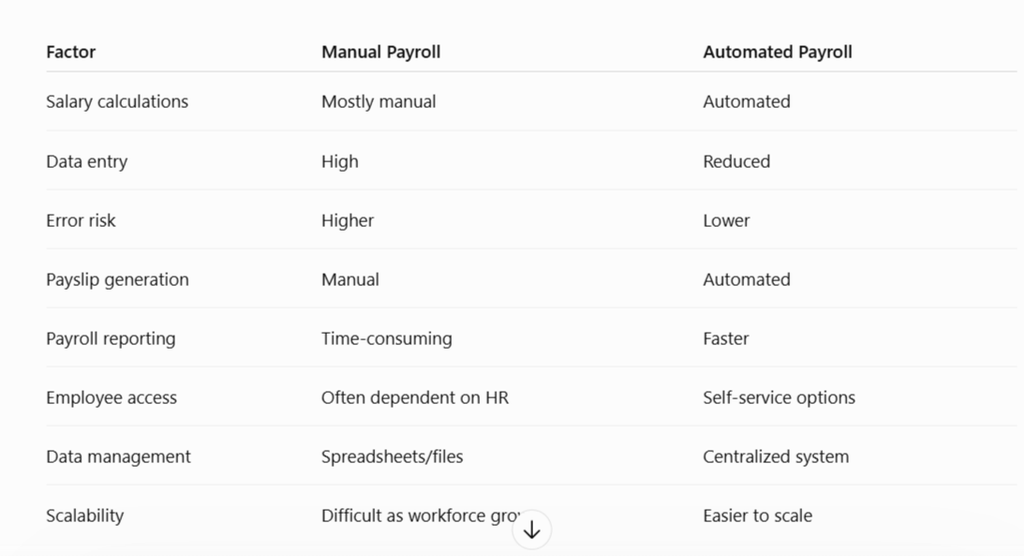
The biggest difference is not simply speed. Payroll automation creates a more standardized and connected payroll process that can support HR teams as business requirements evolve.
How WeekMate Helps Automate Payroll
WeekMate combines HR management and payroll capabilities in one platform, helping businesses manage core HR activities alongside payroll processes.
Its HRMS can connect employee information, attendance, leave, payroll, compliance, and employee self-service within a centralized system. This helps HR teams reduce repetitive administrative work and maintain better visibility across workforce operations.
With automated payroll workflows, businesses can simplify salary processing, manage payroll-related information, generate payslips, and access reports from a centralized platform.
For organizations looking to move away from spreadsheet-heavy payroll processes, an integrated HRMS can provide a more efficient approach to everyday payroll management.
Why Businesses Should Invest in Payroll Automation
Payroll is a recurring business process, which means even small inefficiencies can become significant over time. Repeated data entry, manual calculations, payroll corrections, and employee queries can consume valuable HR resources every month.
The benefits of payroll automation extend beyond faster salary processing. Automation can help businesses:
- Reduce repetitive administrative work
- Improve payroll accuracy
- Standardize payroll workflows
- Support compliance management
- Improve employee access to payroll information
- Strengthen payroll data management
- Generate useful payroll reports
- Scale payroll operations more efficiently
For small businesses, growing companies, and larger organizations, the right payroll processing software can create a more reliable and scalable payroll environment.
Conclusion
Payroll is one of the most important recurring processes in any organization, and manual management can become increasingly challenging as the workforce grows. Payroll automation helps businesses simplify repetitive processes, reduce errors, improve data management, and provide employees with better access to payroll information.
With an integrated HRMS such as WeekMate, businesses can bring payroll, attendance, leave, employee records, compliance, and self-service together in one platform. This allows HR and finance teams to spend less time managing routine payroll tasks and more time focusing on business and people-related priorities.
If your business is looking to simplify payroll and streamline HR operations, explore WeekMate’s HRMS and payroll capabilities to build a more efficient payroll process.