
Every year, clinicians, patients and caregivers come up with strong ideas for apps that could improve care. Very few of those ideas ever reach real users. The gap between a good concept and a working product is where most healthcare application development efforts stall, not because the idea was weak but because the path from idea to launch was never mapped out properly.
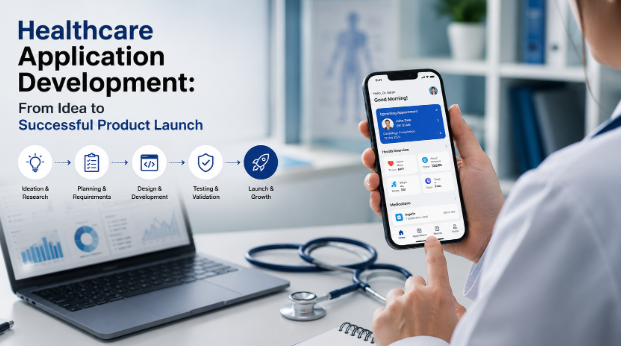
This guide lays out that path in clear stages: validating the idea, understanding regulation early, choosing the right development partner, designing for clinical reality, building in phases, proving clinical value, and planning a launch that actually sticks. Whether the goal is a patient-facing app or a tool for providers, the same sequence separates products that last from products that fade.
Stage One: Validate the Idea Before Building Anything
The most common reason healthcare apps fail is not poor execution. It is building something nobody needed in the first place. Real validation means talking to the actual end users, clinicians, patients or caregivers, before a single screen is designed. The goal is to learn whether the problem is painful enough that people would change their behavior to solve it. If the answer is unclear, the idea needs rethinking, not a prettier interface.
Stage Two: Understand the Regulatory Terrain Early
Healthcare carries regulatory weight that most app categories do not, and discovering it midway through development is one of the most expensive mistakes a founder can make. In the United States, apps handling patient information must account for the privacy and security requirements described by the U.S. Department of Health and Human Services, and some products may fall under medical device oversight from the FDA digital health program. None of this needs to be fully resolved before building starts, but it must be understood well enough that the technical architecture does not need an expensive rebuild six months later.
Stage Three: Choose a Development Partner With Healthcare Experience
General app development experience does not automatically translate into healthcare competence. A team with real healthcare application development experience asks different questions: how sensitive the data is, how the product will integrate with existing clinical systems, and how the design fits clinical workflows rather than generic consumer patterns. Ask for specific examples of healthcare products the team has shipped. Vague answers about handling sensitive data usually signal limited real experience with the particular demands of healthcare.
Stage Four: Design Around Clinical Reality
A clinician using an app between patients has about ninety seconds, not the relaxed browsing time most consumer apps assume. A patient managing a chronic condition needs something that fits into an already exhausting routine, not another demanding task. Designing around these real constraints, rather than an idealized version of use, is the difference between an app that gets adopted and one that gets downloaded once and forgotten.
Stage Five: Build in Phases and Validate as You Go
Building the entire envisioned product before showing it to real users is especially risky in healthcare, because the cost of being wrong compounds the longer feedback is delayed. A lean first version focused on the core problem gets real feedback faster and far more cheaply than a fully built product. That feedback often reveals wrong assumptions that no planning session could have predicted.
Stage Six: Treat Clinical Validation as Part of Development
For apps making claims about health outcomes, formal validation matters far more than it does for a scheduling tool. A structured pilot with a healthcare partner, or clinical advisors involved throughout development rather than at the final review, builds the credibility that providers and patients require. Trust is earned during development, not added as a marketing claim after launch.
Stage Seven: Plan the Launch as a Process
Launch day is often treated as a finish line. In healthcare application development, it is closer to the starting point of the work that determines whether a product survives its first year. Thoughtful onboarding of early users, close monitoring of where people drop off, and real support resources for users who hit problems all matter enormously, because healthcare users dealing with their wellbeing have little patience for a confusing experience.
Where the Real Opportunities Still Exist
Beyond the crowded categories most founders target first, several underserved areas show genuine demand. Tools built for caregivers of patients with rare conditions, clinical documentation assistants that reduce administrative burden, discharge planning tools that follow the patient home, and software designed for small independent practices that cannot afford enterprise systems all address needs the large incumbents have largely ignored.
Conclusion
Successful healthcare application development follows a disciplined sequence: validate with real users, understand regulation early, work with a partner that knows healthcare specifically, design for clinical reality, build in phases, prove clinical value during development, and treat launch as the beginning of the real work. It is not a glamorous path, but it is the path that consistently turns good ideas into products people genuinely rely on.
What is healthcare application development?
Healthcare application development is the process of designing, building and launching software for medical and health-related use, including patient apps, clinical tools and administrative systems, with attention to regulation, data privacy and clinical workflows.
How long does it take to develop a healthcare app?
Timelines vary widely by complexity, but a focused first version typically takes several months of design and development, followed by testing, clinical validation and a phased launch. Rushing the timeline often creates expensive rework later.
What regulations apply to healthcare apps?
Depending on the product and the market, healthcare apps may need to comply with data privacy rules such as HIPAA in the United States, and some products may fall under medical device regulation. Regulatory classification should be assessed at the planning stage.
How much does healthcare application development cost?
Costs depend on scope, platform, integrations and compliance requirements. A lean first version costs far less than a full-featured product, which is one reason building in phases is the recommended approach.
Why do most healthcare apps fail?
The most common cause is building something nobody needed, followed by discovering regulatory requirements too late, designing without understanding clinical workflows, and treating launch as the finish line instead of the starting point.
What should I look for in a healthcare app development partner?
Look for specific shipped healthcare products, informed questions about data sensitivity and compliance, experience integrating with clinical systems, and honest answers about timelines and risks rather than vague promises.