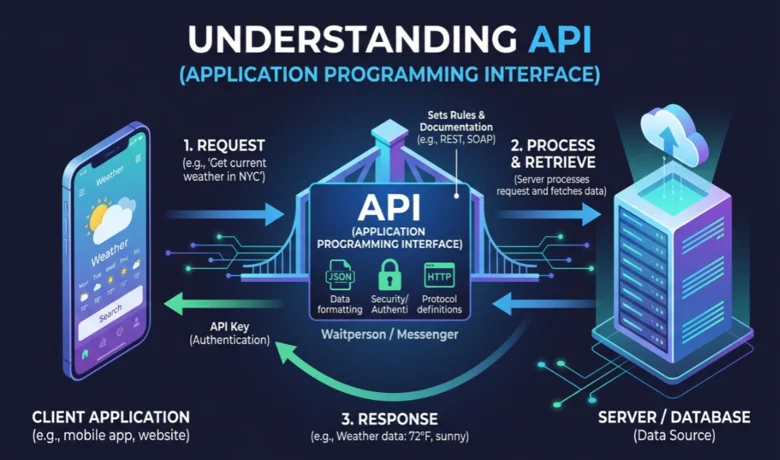

An API, short for Application Programming Interface, is the quiet backbone of the modern internet. Every time you check the weather, pay online or share a photo, APIs work behind the scenes so different software systems can talk to each other. This guide answers the question what is an api in plain language, then walks through how APIs work, the main types, and how developers build and secure them. For more explainers on core tech concepts, browse our technology section.
What Does API Stand For
API stands for Application Programming Interface. Each word carries meaning:
- Application: any software built for a specific purpose.
- Programming: the code that lets systems interact.
- Interface: the point where two systems meet and exchange information.
The term dates back to the 1960s and 1970s, but APIs became central to web development in the 2000s with the rise of web services. Today almost every app you use depends on them.
How Do APIs Work
Think of an API as a waiter in a restaurant. You, the customer, place an order, which is the request. The waiter carries it to the kitchen, the server, and brings back your food, the response. You never need to know how the kitchen works. APIs follow the same request-response pattern, usually over HTTP or HTTPS, using methods such as GET, POST, PUT, DELETE and PATCH.
Every API call involves a few key parts:
| Component | Role |
|---|---|
| Endpoint | The URL that receives the request, such as https://api.example.com/users |
| Method | The action the client wants, for example GET to read or POST to create |
| Headers | Metadata such as authentication tokens and content type |
| Body | The data payload, usually in JSON or XML format |
| Status code | The result signal, such as 200 OK for success or 404 for not found |
The Main Types of APIs
REST APIs
REST, or Representational State Transfer, is the most popular architectural style for web APIs. Defined by Roy Fielding in 2000, it treats everything as a resource identified by a URL and manipulated with standard HTTP methods. REST APIs are stateless, cacheable and layered, which makes them simple to scale. That simplicity is why REST became the default choice for most web and mobile applications.
SOAP APIs
SOAP, the Simple Object Access Protocol, is a strict XML-based standard maintained by the W3C. It includes built-in error handling and WS-Security features, so banks, payment networks and ERP systems still rely on it where reliability matters more than speed. The trade-off is verbosity: SOAP messages are heavier than modern alternatives.
GraphQL APIs
GraphQL, developed at Facebook, is a query language for APIs. Instead of receiving fixed responses from many endpoints, the client asks for exactly the data it needs in a single request. This solves over-fetching and under-fetching, supports strong typing through schemas, and enables real-time updates via subscriptions.
WebSocket APIs
WebSockets keep a persistent two-way connection open over a single TCP channel. Unlike the usual request-response cycle, either side can push data at any time. That makes WebSockets ideal for live trading dashboards, chat apps such as Slack, collaborative editors and multiplayer games, where low latency matters.
RPC APIs
Remote Procedure Call APIs let a program run a function on another server as if it were local. JSON-RPC and XML-RPC are common flavours. RPC is direct and simple for calling functions but less flexible for complex data exchange.
Public, Private, Partner and Composite APIs
APIs are also grouped by who can use them. Private APIs stay inside one organisation, connecting internal systems securely. Public APIs, such as those from Google Maps, OpenWeatherMap and GitHub, are open to outside developers and usually need registration. Partner APIs are shared with selected business partners under contract. Composite APIs bundle several calls into one request to cut latency, which helps mobile apps on slow networks.
Why APIs Matter for Business
- Integration: CRM, ERP, payment gateways and analytics tools join into one connected system.
- Innovation: opening key functions lets third-party developers build apps, plugins and extensions, as Twitter and Shopify showed.
- Expansion: companies reach new markets and partners without rebuilding infrastructure, and API monetisation can create new revenue.
- Maintenance: modular design means backend changes stay invisible to clients as long as the contract holds, which eases updates and scaling.
How to Secure an API
Security is non-negotiable. The standard toolkit includes OAuth 2.0 and JWT tokens for identity, API keys combined with IP whitelisting and rate limiting, HTTPS everywhere, input validation, and centralised control through an API gateway. Gateways such as Kong, AWS API Gateway, Apigee and Azure API Management add routing, authentication, monitoring and throttling in one place, which protects against abuse including DDoS and injection attacks.
How to Build an API in 5 Steps
- Plan: define goals, model resources, choose an architecture such as REST or GraphQL, and write requirements in OpenAPI format.
- Build: pick a stack such as Node.js with Express, Python with Django or Java with Spring Boot, then implement endpoints, logic and error handling.
- Test: run unit, integration and end-to-end tests with tools such as Postman, Newman, Jest or PyTest.
- Document: publish interactive docs with Swagger UI, ReadMe or Docusaurus, covering auth, endpoints, schemas, code samples and error codes.
- Launch: list public APIs on directories such as RapidAPI and the Postman Network, and grow adoption with portals, blogs and community support.
What Is an API Gateway
An API gateway is the single front door for many backend services. It handles routing, authentication, rate limiting, logging and transformation, giving microservice architectures one managed entry point with better security and observability.
What Is an API FAQs
What is an API in simple terms?
An API, or Application Programming Interface, is a set of rules that lets two software systems communicate. One system sends a request and the other returns a response, without either needing to know how the other works inside.
What is the difference between REST and SOAP?
REST is a lightweight architectural style using standard HTTP methods and usually JSON, which makes it fast and scalable. SOAP is a strict XML-based protocol with built-in security and error handling, preferred in banking and enterprise systems where reliability matters most.
What is GraphQL and when should it be used?
GraphQL is a query language that lets clients request exactly the data they need in one call. It suits apps with complex data needs and avoids the over-fetching common with REST.
What is an API endpoint?
An endpoint is the specific URL where an API receives requests for a resource or action, for example https://api.example.com/users. Well-designed endpoints with authentication and rate limits protect the API from misuse.
How do developers keep APIs secure?
Common measures include OAuth 2.0 or JWT tokens, API keys with IP whitelisting, HTTPS encryption, input validation, rate limiting and an API gateway for centralised monitoring.