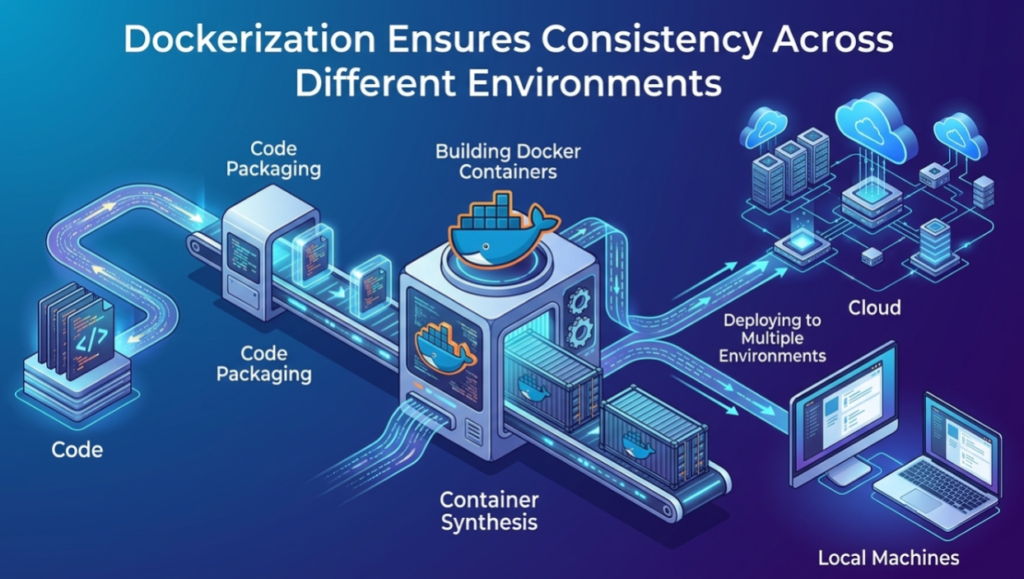

Imagine a master chef who perfects a secret recipe in their home kitchen — every spice measured, every flame calibrated. Now picture them trying to recreate that same dish in a restaurant across the world, only to discover different ovens, missing ingredients, and unfamiliar equipment. The dish collapses. This is exactly what software developers faced for decades — code that worked flawlessly on one machine crumbling the moment it touched another environment.
Docker changed that story entirely. Think of Docker not as a tool, but as a universal shipping container — the kind that transformed global trade by letting cargo move seamlessly between ships, trains, and trucks without repacking. With Docker, your application, its libraries, its configurations, and its runtime all travel together in one tamper-proof box. Wherever that box lands — a developer’s laptop, a cloud server, or a production cluster — everything runs exactly the same.
Building the Box: What Goes Inside a Docker Container
A Docker container begins as an image — a precise, layered blueprint of your application’s universe. Think of it like a nesting doll: the outermost layer is your application code, beneath it sits your framework, deeper still lives the operating system runtime, and at the core is a minimal Linux kernel. Each layer is immutable and cacheable, making builds lightning-fast.
When Netflix began containerizing its microservices, engineers discovered they could spin up isolated services in milliseconds rather than minutes. The containerized environment eliminated the infamous “works on my machine” syndrome overnight, allowing hundreds of developers to collaborate without environment conflicts.
For anyone enrolled in a full stack developer course in pune, mastering Docker images and containers is no longer optional — it’s foundational. The ability to Dockerize a Node.js backend, a React frontend, and a PostgreSQL database into a single cohesive environment is now a baseline expectation in the industry.
Setting Sail: The Docker Workflow from Dev to Deployment
Writing a Dockerfile feels almost poetic — a short script that narrates your application’s entire story from a blank slate to a running service. You declare a base image, copy your code, install dependencies, expose a port, and define a startup command. That’s it. That document becomes the single source of truth for every environment your application will ever touch.
Spotify leveraged this model to unify its engineering teams spread across Stockholm, New York, and Boston. By standardizing Docker as the deployment unit, they eliminated environment drift — the slow, invisible decay that causes staging environments to diverge from production. Their deployment pipelines became deterministic, predictable, and dramatically faster.
Orchestrating the Fleet: Docker Compose and Beyond
A single container is powerful. An orchestra of containers — a web server, a cache layer, a message queue, a database — running in harmony is transformational. Docker Compose lets developers define multi-container applications in a single docker-compose.yml file, launching entire ecosystems with one command: docker-compose up.
For larger scales, tools like Kubernetes take this concept further, managing thousands of containers across global server clusters, auto-scaling based on traffic, and self-healing when containers crash. Airbnb used container orchestration to handle unpredictable traffic spikes during peak travel seasons, ensuring their platform remained responsive even when demand surged tenfold overnight.
Those pursuing a full stack course in Pune will find Docker Compose particularly relevant — it mirrors real-world architectures where frontend, backend, and database services must communicate locally before they ever reach the cloud.
Why Docker is the Developer’s Superpower
Docker doesn’t just solve deployment problems — it reshapes how teams think about software. It enforces discipline around dependencies, encourages modular architecture, and creates a shared language between developers and operations teams (the foundation of DevOps). CI/CD pipelines become cleaner. Rollbacks become trivial. Environment parity becomes a guarantee, not a hope.
Learning Docker as part of a full stack developer course equips developers with the confidence to build applications that are cloud-ready from day one — whether deploying to AWS, Google Cloud, or Azure.
And for developers in India’s booming tech ecosystem, a full stack course in Pune that includes Docker training is an investment that pays dividends immediately, as companies across sectors — fintech, healthtech, SaaS — now list containerization skills as non-negotiable in job descriptions.
Conclusion
Docker didn’t just solve a technical inconvenience — it rewired the DNA of modern software delivery. Like that universal shipping container that revolutionized global trade, Docker made application deployment predictable, portable, and powerful. The chef can now carry their perfect kitchen anywhere in the world, and the dish will taste exactly as intended. In a world where speed and reliability define competitive advantage, Docker is not merely a tool — it’s the language of modern engineering.
Name – Full Stack Developer Course In Pune
Address – Office no- 09, UG Floor, East Court Phoenix Market City, Clover Park, Viman Nagar, Pune, Maharashtra 411014
Phone No – 095132 60566
Email – enquiry@excelr.com